
Don’t feel like scrolling? I made YouTube and Spotify playlists!
I have a dozen or so incomplete travel posts that are very long and still a ways away from finishing. Some, about places I visited over four years ago, are basically abandoned. Some would require weeks of devoted writing to complete. They are all close to my heart, and they all haunt me.
The unfinished post I think about the most is the Tamil music post. It began in 2021 when I spent about two and a half months traversing Tamil Nadu. I was to launch my blog with a series of posts on the places I visited and on the state’s cultural output, but none of this was ever finished (and the blog didn’t launch for another 3 years) because I got sidetracked by the music post.
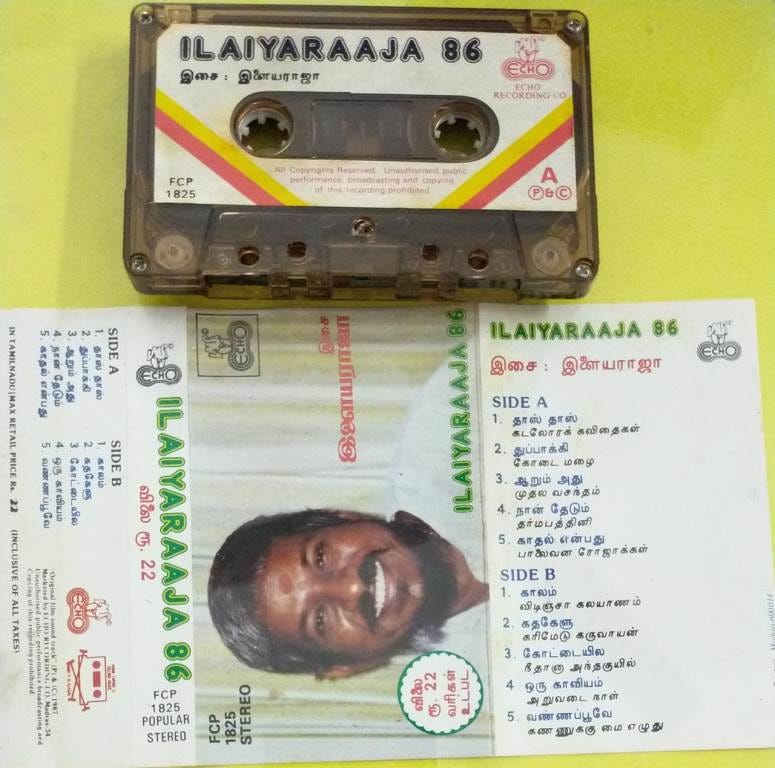
I was mostly writing about A.R. Rahman, my pick for the greatest music artist of my lifetime (I was born in 1990), and included a scattering of other Tamil film music that I liked. I knew of Ilaiyaraaja, though, whom I’d often seen referenced as the great pre-Rahman artist of Tamil film music. Though I’d heard some random songs of his over the years, I never dove in. I thought if I was going to actually make a post on Tamil music, I’d need to get to know Ilaiyaraaja’s music.
Getting into Indian film composers is quite a task since they are remarkably prolific, and Ilaiyaraaja is perhaps the most prolific of all. According to wikipedia, “in a career spanning over forty-nine years, he has composed over 6500 songs [and] provided film scores for nearly 1500 feature films in nine languages.”1 Getting into Ilaiyaraaja isn’t something that can be done in a few weeks.
I ended up listening to Ilaiyaraaja daily for… over six months? It was a crazy time. I fell in love with his music and became kind of obsessed. I definitely heard a few hundred albums, which means I barely scratched the surface. Where do you even start with an artist with such a massive discography, especially when googling “best Ilaiyaraaja albums” yields next to nothing? I chose which albums to listen to by going through all that I could find from films with major Tamil stars (Kamal Haasan, Rajnikanth) and directors (Mani Ratnam, K. Balachander, Balu Mahendra), as well as all of the award winners. I later followed the same formula for his Telugu works. Beyond that, I listened to a lot of random songs and albums, and sampled his non-film work.
I wanted to learn more about Ilaiyaraaja before writing about him, but there are no English-language books about him, and no in depth articles or essays talking about his artistic development and contextualizing him in the Indian music scene. I pored over the limited resources I could find (the best is actually film critic Baradwaj Rangan’s website, for both the articles and the comments, and I found some good but short scattered articles such as this one focusing on his embrace of electronic sounds) but it just reminded me of how little I knew, even though I began to rank him among my favorite artists. I often fantasize about going back to Tamil Nadu for months, devoting myself to the study of Ilaiyaraaja, using AI to translate Tamil texts about him (including his own books), continuing to immerse myself in his music, and writing a series of posts about his life and art.
Though I frequently think to myself “Gosh, I should really just throw together a quick list of Ilaiyaraaja recommendations, the people need to know!”, I never had the right excuse to do so.2
This changed when I went to see Ilaiyaraaja in concert two weeks ago (an incredible experience, and I must say, his energy is very impressive at 83 years old!), and the entire car ride home I thought to myself, “My goodness, I must write about Ilaiyaraaja!”3
So here we are. I am unqualified and have little of actual value to say about his work. But I know what I like and can share that.
For people new to his work, I’ll give some context. From shortly after his debut in 1976 until A.R. Rahman’s debut in 1992, Ilaiyaraaja was by far the biggest South Indian music director4. The majority of his work is in Tamil, but he has worked extensively in the other South Indian languages.5 He has rarely worked in Hindi films, which is surprising but kind of awesome, as few people from regional industries who are wanted by the Hindi industry are able to resist its lure. (Of the scattered Hindi films he’s done, most were with South Indian directors he previously worked with and/or had remakes of his South Indian songs).
With thousands of songs across many genres and styles, it is hard to easily define Ilaiyaraaja’s music, but I’ll still try.
Though he does work in traditional forms, to me the Ilaiyaraaja signature is in his marriage of sounds, Indian and western, popular and classical. Ilaiyaraaja wasn’t the first Indian music director to fuse eastern and western sounds, but I feel he did so more freely and inventively than anyone before him. It wasn’t just Indian music embellished with western production elements, or vice versa. His music in his prime felt like he had all of these instruments and styles and sounds in his head and could wield them as he pleased, as they’ve never been wielded before, making something that could only come out of his madcap musical imagination. There are songs that have jazz, funk, hippie soft rock, synth-pop, bluegrass, western classical, and Indian classical all in one, and it somehow feels totally normal and organic. His music nearly always has an Indian core, and he brings foreign sounds into it in a way that feels both original and indigenous. Referring to his music as fusion feels wrong, because it doesn’t feel like a self-conscious attempt at fusing styles. It’s just Ilaiyaraaja being Ilaiyaraaja. He is Indian syncretism in musical form.
(There a few other Indian music artists who I’d describe in the same terms, but they all came after Raaja. One major one was Ilaiyaraaja’s former keyboard player, A.R. Rahman.)
Another major component of his style is Indian folk music. Many of my favorite Ilaiyaraaja songs are infectious, intricately arranged folk songs (often spiked with guitars, orchestral arrangements, and synthesizers), and he is credited with bringing folk music to Tamil film music and blending it with Carnatic music. I was surprised that nobody had done this before, but from what I’ve read, Tamil film music was previously dominated by Brahmins and was rooted in Carnatic music. Ilaiyaraaja, who comes from a Dalit family and was brought up in a rural area, was heavily inspired by folk music he heard growing up and touring different villages while performing at communist party events with his brother.
Years later, after moving to Chennai, studying western classical and Carnatic, and working in the music industry under other music directors, he debuted on his own and merged folk instruments and melodies with Carnatic music. That doesn’t sound like such a revolutionary thing to do, but it was deeply controversial and some of his music was banned for it!
“In his very first year of entry into the industry, Ilaiyaraaja composed a song called ‘Kettela Ange’ for the film Bhadrakali (1976), where the lines written in Tamil Brahmanical dialect are set to the folk beats of the parai drum and imbued with a western flavour. The marriage between the parai drum of the lower castes and the Brahmanical dialect was sacrilegious enough for All India Radio to ban this song as well for ‘vulgarity’.”6 From an interesting article by Rajesh Rajamani: https://www.huffpost.com/archive/in/entry/to-appreciate-ilaiyaraaja-s-anti-caste-politics-you-have-to-listen-to-his-music_in_5eda5614c5b6817661649db5
That’s pretty wild and is the sort of thing that I’d never pick up on as I know neither what drums are associated with lower castes nor what dialects are associated with upper castes. India will forever remain unknowable to me.
Raaja has a number of other claimed innovations that I’d like to get a second opinion on, such as bringing harmony to Indian classical music and fusing Indian classical and western classical forms. Was he really the first?7 He also made extensive use of synthesizers, drum machines, and digital recording tech when they were still new, and was perhaps the first in India to use them to such a prominent extent.
I think the “first” stuff is overblown, though, even if it’s true. My very basic, simple one sentence explanation of why he was so successful with a mass audience and with connoisseurs is that he relentlessly cranked out a wide range of songs with catchy and memorable melodies and rhythms, offering immediate surface-level appeal while also having intricate arrangements that are full of surprises and sound fresh to this day. His innovations only matter insomuch as they help him create songs that elicit an emotional response from the listener.
Film critic and music connoisseur Baradwaj Rangan (whose writings and comments section, as I mentioned above, have been a major source of my Ilaiyaraaja knowledge) wrote a great essay about what it was like growing up as an Ilaiyaraaja fan in Chennai in the 80s. I think this captures the Raaja magic better than I can:
“It’s like one man in Madras was putting out at least one ‘Thriller’ every month. In Tamil. In Telugu. In Kannada. In Malayalam. In pop. In rock. In folk. In jazz. In Western Classical. In Carnatic. In Hindustani. The very Western-sounding beginning of ‘Kodai kaala kaatre’ would give way to an interlude in which a solo violin would start playing like a coconut-shell fiddle from a village deep South. Or, in ‘Manjal andhi velaiyo’, an electric guitar would glide through Carnatic-sounding passages that a lesser composer might have used the veena for.
It’s not that the music could be enjoyed only with all this analysis, either. All of Ilayaraja’s hits straddled the breadth of appeal with depth of musicianship. So after you got past the instant appeal of the song, you’d realise what was beneath the beats and the voices and the immediately apparent instruments. You’d see, for instance, a bass guitar hugging the voice. You’d see counterpoints, even if, at the time, you didn’t know the word for them was ‘counterpoints’.” https://baradwajrangan.wordpress.com/2016/05/21/10874/8
You can’t talk about Ilaiyaraaja without bringing up his massive output. It’s hard to wrap your head around someone making over six thousand songs. How is that even possible?
Ilaiyaraaja’s speed is part of his legend. If you go to the Wikipedia page for many of his films, you’ll see quotes such as this: ‘Ilaiyaraaja finished composing the entire soundtrack in “half a day”’ (referring to one of his finest soundtracks, Thalapathi), and this: ‘The song “Vizhiyil Vizhundhu”, set to the Carnatic raga Suddha Dhanyasi, was composed within 10 minutes while the other songs were composed within half an hour.’ (referring to the album Alaigal Oyvatillai, which contains his very famous song Kadhal Oviyam which did not make my list).
I didn’t believe these stories when I first heard them, but they seem to actually be true, based on a bunch of quotes I found from different filmmakers. He is preternaturally prolific and seems like a workaholic, and he works incredibly fast.
To be clear, he’s not creating a full song in 15 minutes. My understanding of his process, which was once fairly typical for music directors (some of whom also share his speed), is that he meets with a director who narrates the story of the film to him and explains what songs are needed. Then Ilaiyaraaja comes up with songs on the spot on his harmonium (using dummy lyrics), with the director (and possibly other members of the team) offering suggestions for adjustments as needed. A number of musical ideas may be explored, and how fast a song takes depends on how quickly the filmmakers decide they’re happy with what they’ve got.9
Afterward, lyrics are added by a lyricist, parts for different instruments are written (I believe mostly by Ilaiyaraaja himself, which differs from most music directors who have arrangers), and then they go into the recording sessions, which is generally at a later date but sometimes happens the same day as he comes up with the songs.
He is also famously fast at creating the background scores (a process known as “re-recording”) for films. From a highly reputable source: “In the 1980s, there used to be up to 15 films releasing for festivals like Diwali, Pongal and Tamil New Year. Raja sir used to be the composer for at least 10 of those films. Producers used to queue up outside his studio in the hope that he would complete the re-recording of their film. He used to manage the re-recording of three films in a single day, without any sleep; nowadays composers take 30 days for a single film!” (Source: Rajnikanth!)
Another part of the Ilaiyaraaja legend is his musical depth. My song list is going to focus on his popular film songs (not as a rule, but just because that’s what I love most), which are incredibly varied10, but he has also done many non-film albums. There’s his aptly titled Indian/western classical-electronic-fusion album How to Name It?, his Carnatic album with U. Srinivas, his many devotional albums, his Thiruvasagam oratorio, and most recently his symphony.11 I really like all of this but can’t really assess any of it. I’d love to hear thoughts on these from people more attuned to their forms than I.
To me, these works are special because they give a portrait of someone who has dedicated his life fully to creating and exploring music. One of the stories I read (in an academic paper) said that at his peak, when he was composing dozens of albums a year, he would wake up at 4am to take Carnatic music lessons before he had to go into the studio. There are also many stories of how, despite being highly paid as a composer (allegedly on par with film stars in his prime), he would regularly take massive pay cuts to work on low budget films, where perhaps he felt he could do more interesting work (this is how he started his incredible run with Mani Ratnam, as explained in the book Conversations with Mani Ratnam).
Raaja’s vast range and output made it interesting to put this list together, because my list turned out so different from others I saw. I found a bunch of lists where hardly any songs in their top 10 or 20 even made it into my shortlist of around 100 songs. That wouldn’t be possible for any of my favorite western music artists.
As of writing this, Ilaiyaraaja is 83 years old and has been a music director for 50 years. Gone are the days when he’d put out over 50 albums in a year, but… he still put out nine albums in 2025! I haven’t heard any of them. I haven’t even heard of any of them. Around 95% of his music that I’ve heard from him is from his golden run between the late 70s and mid 90s. I believe the newest song I included on my list is from 1994. From what I’ve heard of his later work, primarily late 90s and 00s, he was still doing some great work, and his music got more polished and had a further focus on orchestral arrangements, but I seldom found the vibrant imagination or the magical melodies anymore. I suspect if I were to deep dive into his later work I’d find some hidden gems.12
Ilaiyaraaja hasn’t been one of the big name composers, who major stars and directors turn to, in decades. While I don’t expect that to change, we actually seem to be on the cusp of a… Rajassance. In the next year he has Tamil films lined up with Karthik Subbaraj, R. Balki, Mari Selvaraj, and Thiagarajan Kumararaja (director of my favorite Tamil film of the past decade), which is a pretty exciting lineup.13 I find it wonderful that the Raaja story is still going, and he’s still giving music his all.
Okay, that’s enough background14, onto the list!
But first, some housekeeping before we get down to business:
I’ve put the names of the films the songs are from in parentheses. I’ve grouped songs from the same album together.
Ilaiyaraaja sang on some of these, but they mostly have other singers. I note the singers on occasion but usually don’t mention it. The most common male vocalist on the list is probably S. P. Balasubrahmanyam (SPB), who has apparently recorded more songs than anyone in history with over 50,000. He’s my favorite Indian singer. Most of the female vocals are by either S. Janaki or K. S. Chithra, who are both phenomenal. A few songs are sung by Kamal Haasan, who is one of my favorite actors.
I will note the exceptions, but most songs are in Tamil, with a number of Telugu songs as well.
The sound quality is hit and miss. In some cases it may be the particular upload, but there are also just inherent limitations to the source material. I personally like the rough around the edges feel of older music, but even then there are times I wish the sound were cleaner and better balanced. I found what sound like “restored” versions of some of these songs but they often sounded a bit off to me, so I avoided them. I apologize that I can’t offer a listening experience with a consistent volume level from song to song.
I have no idea what any of these songs are about.15
I encourage everyone to dig deeper into his catalogue! A good starting point is to listen to the full albums for songs that I’ve linked to, which, at least some of the time, lets you see how his albums can be sonically cohesive and not just a collection of songs. And check out some of the scattered songs, albums, and playlists I linked to across the many footnotes. Google around for more songs, as most people’s favorites diverge from mine quite a bit. If you fall in love with a particular album, check out more albums from films by that director. I’d recommend seeking out the movies, too, but it’s hard to find them with decent picture quality, which is why I’ve seen so few. Also, a number of them will be unwatchably bad, so there’s that, but I’d expect around half the films on this list to be good.
I originally numbered these from 50 to 1, but I got frustrated ranking them in order since so many of them were a tie, so I removed the numbers. Also I think it’s actually 51 songs. I went crazy trying to narrow it down to 50, and embarrassingly spent hours going back and forth on a bunch of songs and just gave up. I put some runners up in the footnotes.16
And now, without further ado, enjoy the wonderful sounds of South India!17 And let me know what you think, whether you’re a Raaja virgin or an established Raaja Rasik.
My 50 Favorite Ilaiyaraaja Songs
Janani Janani (Thaai Mookambikai)
I actually hadn’t heard this until Ilaiyaraaja opened his concert with it. I wondered if it was a traditional devotional song, but it’s an original song from an obscure 1982 religious film. Gorgeous song. Is it really top 50 worthy? Probably not, especially since it is less distinctive than the rest of the songs on here, but it has sentimental value for me, being the first song I heard from him live, and it feels right for it to be the first song here.
Janavule Nerajanavule (Aditya 369)
I thought this Telugu song was one of my favorites (the whole album from 1991 is a lot of fun), but upon re-listening it’s just very good. It’s a lovely song with a sweet melody. But a bit repetitive and I find the instrumentation to be too prominent. I’d prefer more delicate production. But it was grandfathered into my list and anyway it’s still good stuff. A nice throwback to an older era of film song. It has sentimental value for me, having listened to it repeatedly in Hampi since the song is apparently set in Vijayanagar.
Nila Kayuthu (Sakalakala Vallavan)
I really like this 1982 song on a number of levels, but what makes it special for me is that the music sounds like it could be looped for one of those songs three-quarters of the way through a ~2000 rap album where they drop the gangster posturing and get all soft and nostalgic on you.
Anbe Nee Enna (Pandian)
Delightfully catchy. Very Rahman-esque melody, from 1992, the same year as Rahman’s debut.
Tham Thananam (Puthiya Vaarpugal)
This 1979 song goes hard!
Kalyana Ramaan (Karaiyellam Shenbagapoo)
This 1980 song is classic old school Ilaiyaraaja. Low-fi, irresistible melodies, and a catchy interplay of Indian and western sounds.
Singari Pyaari (Athisaya Piravi)
Lovely Tamil synth pop. The whole 1990 album is great!
Paattukku Paattu (Athisaya Piravi)
Silly dance song, very fun. Even better when you know that it takes place in a film where Rajnikanth goes to heaven where they’re playing Carnatic music and he tells them that the audience will walk out of the theater if they don’t play “break, disco, rock & roll!”
Unna Paartha (Athisaya Piravi)
A remarkably sweet, catchy, melodic tune.
Nilaave Vaa (Mouna Ragam)
The main chorus part is a bit sappy but overall this 1986 song is really lovely!
Vaanengum Thanga (Moondram Pirai)
Jazzy Tamil easy listening synth pop from 1982. Super catchy but with a lot going on. Though I’m not including other songs from the film, it’s a great album, every song is interesting and unusual and complex.
Putham Puthu Kaalai (Alaigal Oivathillai)
There’s a lot of Ilaiyaraaja songs that leave you wondering where they’re going for most of the runtime. This 1981 track has an incredible central melody, but it teases it rather than leaning on it, driven more by the arrangements than a traditional pop song format. It could be more satisfying, but I love its musical freedom.
Rasave Unnai (Thanikkattu Raja)
Another one that could have coasted on its sweet central melody, but this 1982 decides to zig and zag and genre hop instead. I may have preferred a more conventionally satisfying song, but it’s still a joy.
Peigala Bhoodhama (Mahanadhi)
Very fun folksy song from 1994. I like Kamal Haasan as a singer.
Vikram Vikram (Vikram)
The 1986 spy thriller’s title track on what is said to be the first Indian film album recorded with a computer. 80s cheese, sure, but the Tamil electrofunk jazz fusion has a lot going for it. Plus you got Kamal Haasan doing weird rap stuff. This song plays in my head whenever I meet someone named Vikram. I like the whole album.
En Jodi Manja Kuruvi (Vikram)
Tamil Spaghetti Western Hava Nagila. I found it embarrassing at first, but its excellence crept up on me. The direction it goes in is actually magical. It’s better the further it gets from Hava Nagila, but it’s the Hava Nagilaness of it all that makes it so absurdly wonderful.
Potta Padiyudhu (Sathyaa)
Kinda goofy but infectious jazzy Tamil synth pop fusion from 1988. I always love it when Kamal Haasan sings.
Nagaru Nagaru (Sathyaa)
Really sweet, catchy song!
Thaamaraikodi (Aanandha Kummi)
Lovely, catchy, beautifully produced pop song from 1983 that sounds like something Rahman would do, though it’s from a decade before his debut. This whole album is banging.
Oru Kili Uruguthu (Aanandha Kummi)
Goes hard. Very hip hop.
Kiss Me Hello (Shiva)
Super catchy 80s pop, my favorite song on the great 1989 album. I had to cut the funky Botany from the list. Here’s an explanation of the wrong number phenomenon:

Thenpandi Cheemayile (Nayakan)
I didn’t like the Nayakan album much until I saw the excellent 1987 film. Once I did, I was like “Wow, that’s a great soundtrack!” I’ve linked to the version of the song that plays in the opening credits, which should put you in the right headspace for it.
Ada Rama Nee Nammakitta (Thoongathe Thambi Thoongathe)
Wonderful, irresistible 1983 pop song!
Abbanee (Jagadeka Veerudu Athiloka Sundari)
Stone cold Telugu electro-funk classic. Goes hard, you could play this in a strip club in Atlanta and it wouldn’t feel out of place. (I mean, maybe, I don’t know, someone should test it out.) I love the whole 1990 album.
Mana Bharathamlo (Jagadeka Veerudu Athiloka Sundari)
So much fun! A++ South India road trip music.
Andalalo (Jagadeka Veerudu Athiloka Sundari)
One of my favorite Sridevi songs. An angelic song for an angelic being.
Raja Kaiya Vachchaa (Apoorva Sagodharargal)
This 1989 song is super corny but also very catchy, and when it drops the overblown carnival stuff it’s actually pretty great!
Ammaava Naan (Apoorva Sagodharargal)
Wonderful folksy tune, with Kamal Haasan singing!
Oru Poonga Vanam (Agni Natchathiram)
Excellent 1988 Tamil Dreampop.
Ninnukori Varanam (Agni Natchathiram)
One of the first Raaja songs I fell in love with. The musical prelude is gorgeous, the chorus is infectious, and there’s a wonderful interplay of live and electronic instruments.
Panivizhum Malar Vanam (Ninaivellam Nithya)
I didn’t know this 1982 song until it was referenced repeatedly in the Tamil novel The Abyss by Jeyamohan (I recently shared my thoughts on the book in a Substack comment, along with further Jeyamohan discussion, if you’re curious). It’s amazing. A very quintessential Ilaiyaraaja song, combining traditional Indian music with western classical and funk in a way that feels wholly organic.
Neethane Enthan Pon Vasantham (Ninaivellam Nithya)
Another incredible funky fusion song.
Sorgame Endralum (Ooru Vittu Ooru Vanthu)
This synth driven track makes me grin ear to ear and makes me want to dance. Ilaiyaraaja sings on this, and while he’s not as good as many of the singers he works with, his voice is perfect on this. The plot of the 1990 movie is “Ramarajan and his dance troupe arrive in a village and face the ire of the regular troupe that performs there each year. Matters worsen when one of his troupe members falls in love with an opponent.” Omg.
Kalaivaniye (Sindhu Bhairavi)
This whole 1985 Carnatic album is excellent, and this song is probably my favorite classical song from Ilaiyaraaja. I feel bad at how few classical songs I included, since many are amazing, but to me they feel less distinctively Ilaiyaraaja so were harder to fit in on this list. This one really hits me, though. I’ve heard it dozens of times and always find it mesmerizing.
Unakkum Enakkum (Sri Raghavendrar)
How is a song for a religious film so funky and jamming? The whole 1985 album is great but this song is really special. Raaja’s trying to turn me into a Raghavendra devotee. This was actually the first Ilaiyaraaja song I ever heard, 20+ years ago, thanks to Will.I.Am, but I won’t be linking to it. (Google it if you’re curious/confused.)
Ada Uchcham Thala (Chinna Thambi)
Wonderful singsongy folklike melody with beautiful instrumentation. The whole 1991 album is good stuff.
Ada Puthiyathu Piranthadhu (Thevar Magan)
Wonderful song from this excellent 1993 album. I need to see this movie: “London-educated Saktivelu returns to India and wants to open a chain of restaurants in Chennai. His father, however, wishes that he would stay back and help the villagers, but fate plays its own hand.” I was sad to have to cut the gorgeous Manamagale Manamagale and the terrific folksy Potri Paadadi Penne from the list, but you should hear those too.
Sandhu Pottu (Thevar Magan)
A+ melodies, A++ instrumental interludes, A+++ SPB vocal performance, and Kamal Haasan rapping. Masterpiece.
Vaan Megam Poo Poovaai (Punnagai Mannan)
Gorgeous dreamy synth pop from this wonderful 1986 album, apparently advertised as being “made with computers.” Teenaged A.R. Rahman played synthesizers on the album.
Maamaavukku Kudumaa Kudumaa (Punnagai Mannan)
Insanely catchy.
Yedhedho Ennam Valarthen (Punnagai Mannan)
A sweet, delicate ballad. One of the songs that made me fall in love with Ilaiyaraaja. Stunning vocals from K. S. Chithra.
Vaa Vaa Pakkam Vaa (Thanga Magan)
India’s best song to feature the word “disco” in its lyrics. You should generally be afraid of such things, but this 1983 song is a brilliant musical journey. I wish the corn were dialed down in the second half (a casualty of being a film song), but it otherwise really is fantastic. One of the greatest flute songs of all time.
Oororama (Idaya Kovil)
This 1985 Mani Ratnam film is supposed to be bad but the soundtrack did not disappoint. This one is cheery (and a little cheesy, but in a good way), creative synth pop. Ilaiyaraaja sings on it. It would have been better with a stronger singer, but hearing him on such a lighthearted song brings me joy. I’m sad I had to cut the terrific classical fusion track Kootathile Kovil Pura.
Paattu Thalaivan (Idaya Kovil)
One of those quintessential Ilaiyaraaja tracks. Contains both simple pleasures and musical complexity. Infectious melody, jazzy rhythm, classical orchestrations, playful synthesizers, unusual genre mixing. And like many of the finest Ilaiyaraaja tracks, it’s a wonderful duet between SPB and S. Janaki.
Idhayam Oru Kovil (Idaya Kovil)
I want to learn Tamil for many reasons, but a primary one is to sing along with this song. Poignantly, this is the first song Ilaiyaraaja is credited as a lyricist for.
Sundari (Thalapathi)
A beautiful song on the last and arguably best album that Mani Ratnam did with Ilaiyaraaja, from 1991 (this, of course, is one year before Roja, Rahman’s debut, following which Ratnam did all of his films with Rahman). I was sad to cut the gorgeous, haunting Chinnathai Aval from the list.
Kaattukuyilu Manasukkulae (Thalapathi)
Hardcore percussion driven jam. Hypnotic.
Rakkamma Kaiya Thattu (Thalapathi)
This was my first favorite Iliayaraaja song. It sounds like a pirate adventure. The guitar, strings, snaps, background vocals, it’s all incredible.
Siva Rathiri (Michael Madana Kama Rajan)
I love this whole 1990 album, and was bummed to have to cut a few of the other songs. This has a fantastically dramatic chorus, with an odd, spare electronic backing, and a bunch of unusual jazz and funk and orchestral elements that come in and out. It’s a bit all over the place and not wholly satisfying, but it remains a favorite. It’s like a weird Tamil Prince ballad.
Sundhari Neeyum Sundharan Njanum (Michael Madana Kama Rajan)
One of my favorite of Raaja’s synth-pop songs. Love the melodies and soundscape.
Per Vechalum Vekkama Ponnalum (Michael Madana Kama Rajan)
I don’t know what to say. Insanely catchy with all sorts of great musical touches. It’s a joyful song, but it makes me sad for some reason, as if all of the great things in life have already happened. A natural emotion to feel after you’ve listened to Ilaiyaraaja for weeks and decide it’s time to move on. It’s like the end credits song for a life well lived that went out on a high. One of my favorite songs of all time… but so is every other song on this list.
I’ve seen sources claim he has over 8,000 songs. I have no idea. It’s certainly insanely high either way.
I did write briefly about Ilaiyaraaja in my Telugu music post, though that was mostly about Keeravani, another genius, though less pioneering and without quite the same depth.
I don’t really like concerts and avoid them even for artists I idolize, but my current rule is that if there’s an artist I truly love who has aged beyond a country’s life expectancy, I will go see them. I only see people who are statistically dead. I gotta see Paul McCartney, Stevie Wonder, and George Clinton, and then I’m probably good on concerts for a decade.
In India, the popular music is the film music. Films generally have a handful of songs, give or take, and in charge of the songs (and often the background scores, though that’s less important for this conversation) are the “music directors” who are akin to songwriters and producers.
If you were to ask who India’s answers to, say, the Beatles or Michael Jackson are, it’s hard to come up with analogous artists because the roles are very fragmented. Music directors are in charge of the music but rarely ever write lyrics, which are usually assigned to dedicated lyricists. Music directors sometimes sing but most often leave the singing to someone else, assigning songs to singers like a film director assigning roles to actors. There’s another layer of distance in that the canonical performances of the songs are by the actors in the films playing characters that are singing (well, lip syncing) the songs.
Unlike in English-language popular music, songwriter/producers in India (and especially South India) are actually pretty famous and well known for songs they didn’t sing on the record. To be clear, they are not as famous as major singers are in other countries, nor are they as famous as the film stars, but they are still reasonably famous for what is essentially a behind the scenes role. They tour regularly, give interviews at films’ promotional events, have name and face recognition, and can have pretty passionate fans. Ilaiyaraaja and A.R. Rahman are legitimate major stars.
From a good BBC article about Ilaiyaraaja: “Audiences showered confetti, clapped and whistled when his name appeared in the opening credits. Many watched films repeatedly for his songs, and at his peak he composed music for more than 50 films in a single year. For many films, the music was the draw - helping them stay in cinemas for more than 100 days.”
There are western songwriters/producers who are well known and beloved primarily for songs that are made famous by other singers. The biggest I can think of is Burt Bacharach, followed by some of the musical theater composers, but none seem that famous. And major behind-the-scenes pop music practitioners, from Holland-Dozier-Holland to Max Martin, just aren’t very well known outside of music nerds. My early teenage fave Timbaland was pretty famous, but he was always secondary to the primary performers. There’s really no western equivalent to someone like Iliayaraaja.
Fame aside, Indian music directors differ from western songwriters/producers in some key ways, much of it stemming from making music for films. One is in the rapid pace of output, with 1,000+ recorded songs in a career being completely normal (I can’t find a single western songwriter since Irving Berlin with over 1,000 songs), and another is in the range of the output. Western songwriters and producers certainly make different kinds of songs, but they often have a signature sound and work within a single genre. Meanwhile, Indian music directors are expected to do everything. Though many do have musical signatures, they are tasked with making songs across different subgenres of Indian music and merging that with various types of global music. They interpret rather than copy and I frequently feel their takes on western music beat the original at their own game. Because they work on so many projects, they make a vast range of music over the course of their careers (and even a vast range of music within a given year).
Consequently, Indian music directors lack the consistency of many great western music artists (though some do have very impressive hit rates nonetheless). Unlike with my favorite English-language artists, I don’t advocate being a completist for most Indian artists. Too much “filler.” Also, I’m very album oriented in my listening with western artists, but less so in India, where there can be over a dozen releases in a year and most are undistinguished and may only have one or two noteworthy songs. There are fewer “artistic statement” albums from the great Indian music directors, and though they do frequently make cohesive albums with a distinctive musical identity (more often with the great directors than the middling ones), those aren’t the norm. (I sometimes wish we had a string of killer ~10 song albums from a music director like Raaja. It’d be a fun exercise to put a bunch of them together, clustering a batch of varied but cohesive songs from a 2-3 year period of his career. The themed playlists and collections never seem to pick the songs I’d pick.)
The flipside is that the major music directors blow away nearly all of their western counterparts in terms of the absolute number of great songs they’ve made and the amount of musical territory they’ve covered. I also feel the higher productivity leads to more experimentation within the popular song format. (Just as I sometimes wish my favorite Indian artists had a string of tight albums that act as defining artistic statements, I also sometimes wish my favorite western artists had 10x their output and were forced by commercial pressures to work on a wider range of music. I like to do musical thought experiments, like what if Jam & Lewis had dozens of country songs, but did it their way? )
What I find most exciting about Indian popular music (which is the world’s most underrated popular music) is that it is rooted in traditional music forms that have never stopped evolving, and it incorporates global sounds in an organic way. The genius of Indian popular music is that much of it is a fusion of styles that comes out feeling both entirely natural and distinctively Indian. It is music that couldn’t come from anywhere else in the world, and the best of it is highly inventive and musically free rather than constrained by tradition. I think it’s a shame that most other Asian music industries didn’t follow a similar path, and instead have parallel music scenes for staid, ghettoized traditional music and predominantly westernized (and mediocre) popular music. I’d say Indian film music has the country’s highest quality pop cultural output, with a steady stream of excellence for as long as India has been a nation, in contrast to the generally poor standard of Indian films, where quality is an unexpected surprise rather than a norm (which I say as a big fan of Indian cinema).
One of the ironies of Indian popular music is that the cool hip thing to do is to listen to the independent artists instead of the commercially made film music, but the film music is far more creative and the indie stuff is largely middling, though the 2020s may be reversing that equation.
It’s plausible that Ilaiyaraaja was the single most dominant music artist of all time for a major industry over a decade long period. I wouldn’t be surprised if more than 75% of hit Tamil songs in the 1980s were Ilaiyaraaja songs.
This might not be as big a deal as it sounds, though, as the government run All India Radio was pretty ban happy. For some years in the 50s, they banned film music entirely!
According to T.M. Krishna, an Indian classical musician who wrote a book about Carnatic music: “What makes Ilayaraja an interesting personality from the position of Karnatik music is the way he composed many tines based on Karnatik ragas and juxtaposed them with complex harmonies. Examples of such melodies include ‘Poonkadhave’ (Nizhalgal, 1980), ‘Kundhalile’ (Balanagamma, 1982) and ‘Anandaragam’ (Panneer Pushpangal, 1981). This was something that had never been tried at this level in Indian film music. Though composers like M.S. Viswanathan and T.K. Ramamurthi had used Karnatik ragas as the basis for melodies in the new film music context of the 1960s, their instrumentation did not have this Western classical approach. Ilayaraja was largely successful in this bringing together of unconnected elements from different musical traditions.” It’s also said that by breathing new life into Carnatic music, he made it more appealing and popular with a mass audience.
Rangan mentions the preludes and interludes, which Raaja fans are passionate about. There’s a whole youtube channel devoted to highlighting the best of them! There are definitely songs of his that I don’t rank among his best works but have outstanding preludes or interludes that I adore. I don’t love the song, but the opening of Vegam Vegam is amazing, it sounds like 2001-era Dr. Dre. How has that not been sampled? Sandha Kavigal is a good song, with great interludes, but the prelude here is the best part as well. Fans also obsess over his background scores, here’s one collection.
I found a blog post about Raaja’s process, if you want more detail. It’s pretty extensive and I didn’t read the whole thing. The information isn’t cited but what I read tracks with director interviews I saw. I assume the process has changed over time. Here’s a video of some filmmakers talking about working with Raaja, as well as other Indian musicians talking about his work. It’s primarily in English, unlike most of the videos you’ll find of filmmakers talking about working with him. If you want to see what a song recording is like, here’s a good video.
You can find Youtube playlists of his “psychedelic” songs, “disco” songs, electrofunk and synth-pop songs, Carnatic songs, folk songs, “night melody” songs, “melancholy” songs, guitar songs, bus riding songs (?), and bird songs (?!), amongst others.
The symphony is another Raaja legend. This is his first released symphony, but in the early 90s he composed one which was performed in London. The recording was never released allegedly because a critic gave it a bad review.
Though he’s slowed down from his earlier years, he’s still put around 200 albums since the start of the new millennium. I’ve likely heard around a dozen. The best were probably the two Kamal Haasan films, Hey Ram and Virumaandi, and the 2009 film Naan Kadavul. From these, I sense he remained a great music director, even if he could no longer churn out brilliantly crafted pop songs. For younger readers who prefer newer music, his last big ticket album, the 2012 Neethaane En Ponvasantham, is great. It’s interesting to hear a youthful romance album from a music artist that’s nearly 70. I should note that I generally much prefer older music and most of what I listen to is from before I was born, so even though Raaja was clearly past his prime in the past 30 years, the lack of inclusion of newer songs reflects my own biases as well.
I think the Rajassance began with Viduthalai and its sequel, which have great music that is perfect for the films. And I don’t know if this is meaningful in any way, but his newest song currently has over 8 million views on Youtube.
Especially if you read the footnotes!
This may be suboptimal, but if you have a problem with not knowing what songs are about, you are missing the point of this whole music thing and I feel bad for you. If you think I’m really missing out, consider that I don’t know what most of my favorite English-language songs are about either, and I prefer to keep it that way.
And, for those who keep up with these things, weep at how bad Indian film music has gotten in the past decade.
time for you to move to chennai for good
What a thorough deep dive (even if we're still barely scratching the surface here). I came in knowing nothing of Ilaiyaraaja and now I'm a devoted fan. At first, I was skeptical and clicked on the first song hesitantly out of respect for your taste. By the end, I'd listened to every track you shared, made a playlist of my own and added a few extras of Raaja's that I found. His music really is as unique, wide-ranging and delectable as described.
Amazing piece and a perfect primer for the man. I feel like I just discovered John Williams for the first time.
Also, Stevie Wonder is technically under the average life expectancy (he's 76, the rate for men is 79) but don't let that deter you from checking out his upcoming 'Songs In The Key Of Life Tour.' I can't wait.